Common Reasons for Manuscript Rejection and How to Avoid Them
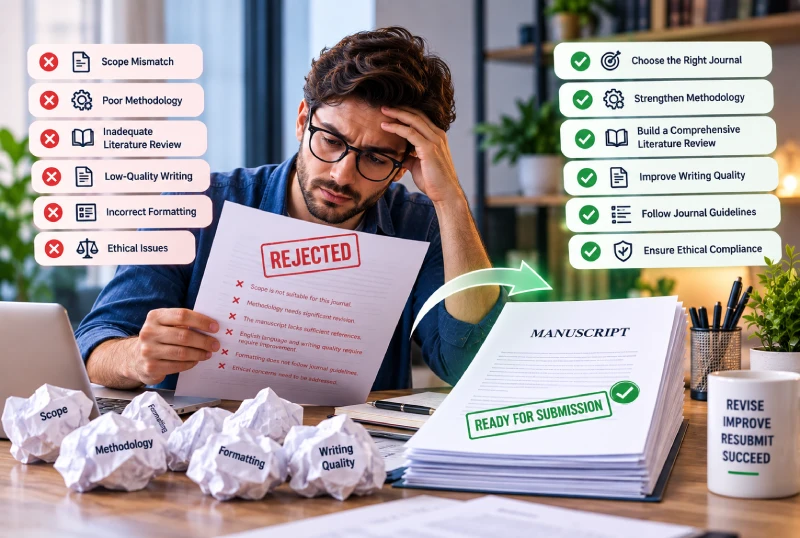
Manuscript rejection is a normal possibility in academic publishing, but researchers can reduce avoidable problems by understanding common reasons papers are rejected. Some decisions are based on the journal’s scope or editorial priorities, while others may involve methodology, presentation, originality, or failure to follow submission requirements.
1. Journal Scope Mismatch
One of the most avoidable problems is submitting to a journal that does not publish research similar to yours. Editors assess whether a manuscript fits the journal’s aims and scope before deciding whether it should proceed further.
Before submission, read the official scope and review recent articles. If your topic, methodology, or article type is outside the journal’s normal coverage, consider a different venue.
2. Weakly Explained Research Methods
Readers and reviewers need enough methodological information to understand how the study was conducted. Missing details about the sample, data, procedures, analytical methods, or research design can make findings difficult to evaluate.
Review your methods section and make sure it explains the process clearly and accurately. Where applicable, include relevant ethics, consent, registration, or data statements required by the target journal.
3. Conclusions That Go Beyond the Evidence
A manuscript should distinguish between what the research demonstrates and what remains uncertain. Conclusions that make claims beyond the results can create concerns during peer review.
Check whether each major conclusion is supported by the study’s data and analysis. Discuss limitations rather than presenting unsupported certainty.
4. Poor Structure or Presentation
Even strong research can be difficult to evaluate when the manuscript is poorly organized. Problems may include an unclear abstract, inconsistent headings, confusing tables, weak figure captions, or inconsistent terminology.
Editing and proofreading can improve clarity, but the manuscript should also be reviewed for logical structure and scientific communication.
5. Failure to Follow Journal Guidelines
Journals have specific requirements for article types, word counts, formatting, references, figures, declarations, and submission files. Ignoring these instructions can create avoidable editorial problems.
Before submission, compare the final manuscript with the journal’s current author guidelines and complete a pre-submission checklist.
6. Incomplete or Inconsistent References
Check that important relevant literature is represented and that citations match the reference list. Incorrect formatting, missing references, or inconsistent citation details can affect the presentation of the paper.
How Taylors and Francis Can Help
Our publication services include manuscript editing, proofreading, formatting, journal selection, submission assistance, and peer-review response support. We can help identify areas that need attention before submission.
However, no service provider can guarantee journal acceptance. The journal, editor, and peer reviewers make the final decision independently.
Final Takeaway
A rejection does not automatically mean that research has no value. Review the decision and feedback carefully, identify the issues that can be improved, and evaluate whether the manuscript needs revision or a different journal. A systematic pre-submission review can reduce avoidable errors and improve alignment with the target journal.